
Colerain Township City Directory Collections
Colerain Township does not have a single municipal directory series. The practical historical shelf is regional: the Cincinnati & Hamilton County Public Library holds local-history material and its Digital Library supplies page-searchable Williams volumes. A result must be read with its geography in mind. A Cincinnati-focused volume may include a Colerain Township address only when that year and edition covered it, while the county editions provide separate town and village listings in some years. For Colerain Township research, the catalog and research desk are the right fallback when a street, smaller community, or year is missing online.
| Collection | Verified years | Where held | Access route |
|---|---|---|---|
| Williams' Cincinnati Directory | 1855 digital example | Library Digital Library | Digitized PDF |
| Williams' Cincinnati Directory | 1901, identified as the 51st volume | Library Digital Library | Digitized PDF |
| Williams directory parts | 1930-31, 1938, 1944 | Library Digital Library | Page-searchable digital parts |
| Williams' Cincinnati directory | 1948, five PDF parts | Joseph S. Stern, Jr. Cincinnati Room collection | Digital item with scanned pages |
| Hamilton County directory set | 1887-1912; 1939-1940 examples | Library Digital Library | County-title search leads |
| Pink Pages and Criss-Cross | Pink Pages from 1925; Criss-Cross from 1941 | Library house-history resources | Address-to-printed-occupant route |
The verified examples establish useful starting points, not an unbroken run for every Colerain Township address. Search the title catalog for the exact year, nearby place name, surname, or street. The Hamilton County digital directory collection is a sound place to test county-title coverage before asking the library about an unlisted volume.
Colerain Township City Directories by Year
The Williams examples show why year matters. The library has a digitized 1855 item, a 1901 title page calling itself the 51st volume, a 1930-31 directory in parts that includes a street-listing portion, and digitized 1938, 1944, and 1948 material. The 1948 record identifies Williams Directory Company as publisher and describes five PDF parts. Its catalog record also places the source in the Joseph S. Stern, Jr. Cincinnati Room collection. These facts support a date-by-date search, not a claim that every household appears in every issue.
For Colerain Township research, use the nearest year on either side of a known event. A first appearance can suggest a move into the directory's coverage area. A disappearance can suggest a move, death, an omitted canvass, a changed street name, or a change in the publication boundary. It does not settle the reason by itself. Save the part number and scanned page with each finding so a later search can revisit the same printed line.
The library's Hamilton County directory results show the county-focused catalog route used to locate these historical leads.
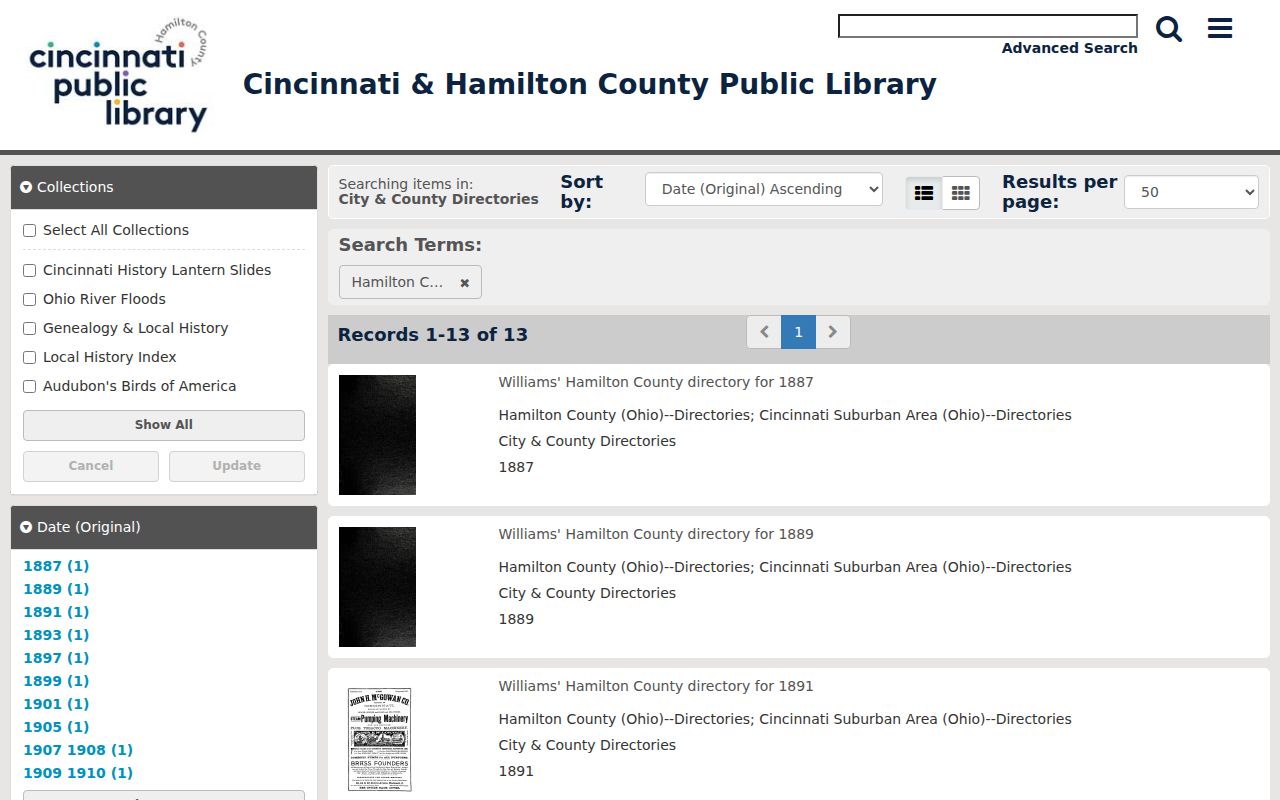
Collection results help separate a verified item from a guessed publication year, which matters before treating a directory gap as a family-history gap.
Note: Preserve the title, year, part, and page because an OCR result alone can misread a surname or a house number.
Reading a Colerain Township City Directory Entry
A 1948 Williams entry used for Colerain Township research may place a private citizen or business in an alphabetical list, a householder and occupant section, or a street-and-avenue guide. The printed line can include a name, a street number and street, abbreviated given names, a telephone exchange or number, a business address, and an occupation-style or organizational notation where the publisher supplied one. Some lines carry a family or relationship notation, but it should be recorded only when it appears. A listed occupant is a historical printed clue, not proof of current residence or ownership.
| Name as printed | Often initials or a shortened forename; try spelling variants. |
|---|---|
| Street address | A house number and street, or a business location, tied to that volume's date. |
| Role notation | An abbreviated occupation or organization reference when the directory prints one. |
| Contact notation | A telephone exchange, number, or business address where supplied. |
| Relationship clue | A spouse or household form only when the line actually gives it. |
| Source citation | Year, publisher, page or image, and PDF part; use the scanned page to check OCR. |
- Criss-Cross directory
- An address-ordered portion of a directory that helps turn a street number into a printed name or occupant clue.
- Householder index
- A section arranged around householders or occupants rather than a broad alphabetical business list.
- Abbreviation key
- The volume's explanation of shortened forms; read it before expanding a printed notation into a fact.
The digitized 1948 Williams directory provides a concrete example of the alphabetical, householder, occupant, and street-guide formats.
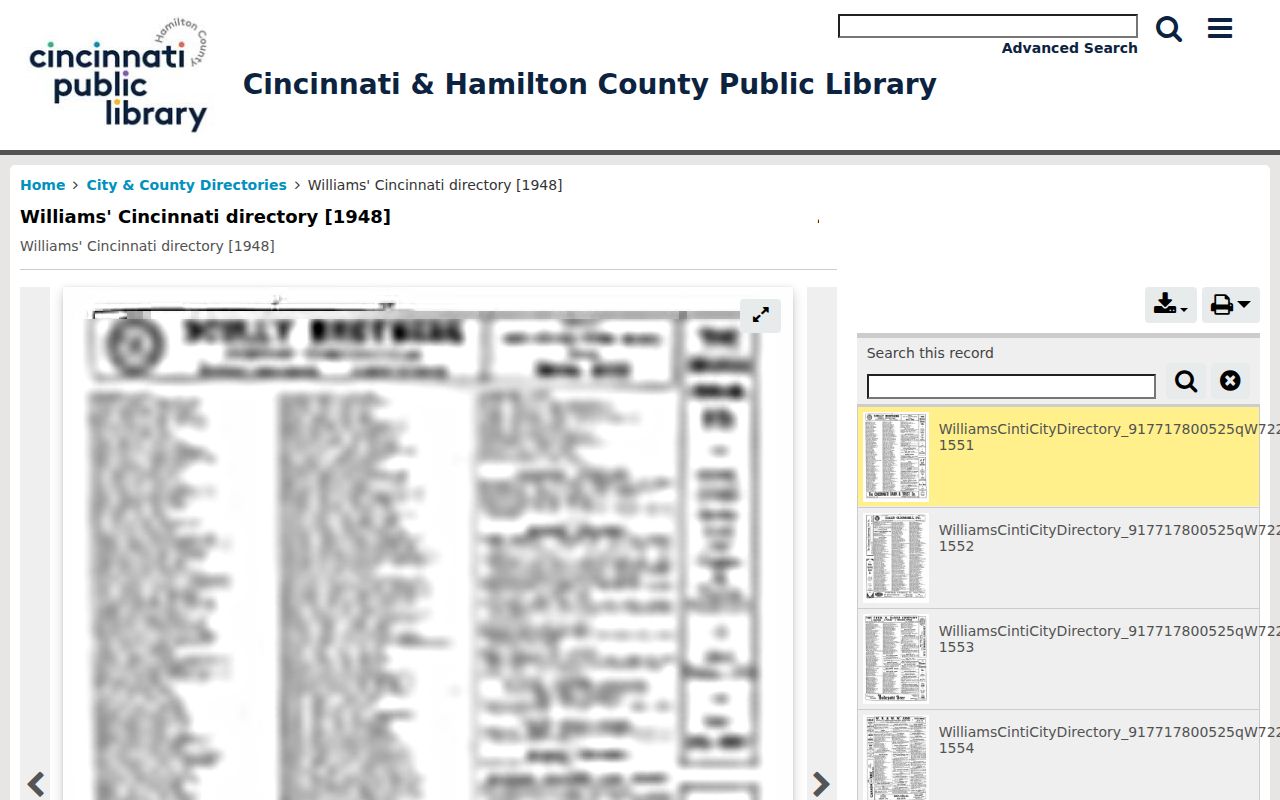
Open the image behind a search hit before copying it into a research log, since the library warns that OCR is not always accurate.
Colerain Township Criss-Cross Directories
Colerain Township address work calls for a different part of the volume than name work. The library's house-history material says Cincinnati city directories begin in 1819, Pink Pages began address-by-street indexing in 1925, and the series was called Criss-Cross from 1941. For a Colerain Township address that appears in a covered edition, look in the street guide or householder section first, then compare the alphabetic name section. That order tests the address rather than assuming a surname belongs to the same property.
Colerain Township street spellings, rural routes, and publication geography can change over time. Record what the guide prints, including directionals and abbreviations. If the number no longer fits a later address, retain the street guide page, tax-map references, plat clues, and legal description instead of forcing an old entry into a current numbering pattern. The research did not verify a township-wide renumbering year, so no such date should be assumed.
The library house-history guide explains the Pink Pages and Criss-Cross address path.
The address-first approach keeps an old printed clue distinct from the modern parcel and deed work used to confirm land title.
Tracing Colerain Township Directory Households
Follow a Colerain Township household through the closest available years rather than leaping from one isolated listing to a conclusion. Begin with an exact street and number from a later document or parcel record. Check the scanned street guide, capture every spelling and abbreviation, then move forward and back through available volumes. Pair those dated lines with the released federal census. Directories fill the years between census snapshots, while the census supplies household relationship, age, and birthplace context that a short directory line often lacks.
- Find the nearest digitized or cataloged year using the street, name, or a nearby community such as Bevis, Dunlap, Groesbeck, Northgate, or White Oak.
- Read the street or householder section, then capture the scanned page, volume year, publisher, part, address spelling, and printed name.
- Check nearby directory years for a new surname, a changed number, or a disappearance, treating each change as a question to test.
- Pair the dates with the appropriate released federal census, whose current public endpoint is 1950, to compare household context.
- Confirm an ownership claim through the Auditor and Recorder chain; use a cemetery, obituary, Probate record, or later court record to test a move or death hypothesis.
The Public Library's Genealogy & Local History Department is the counter and catalog fallback for this work. Its guide identifies the Main Library at 800 Vine Street in Cincinnati, telephone 513-369-6905, and collections that include directories, census material, maps, Ohio death certificates, and surname-indexed works. When a historical name needs a later identity check, the Colerain Township resident lookup provides the current-record angle without turning a historical listing into a present-tense claim.
Colerain Township Directory Geography
Colerain Township is an unincorporated township in Hamilton County, so its older address trail is often regional rather than city-clerk based. Local terms such as Barnesburg, Bevis, Dry Ridge, Mount Healthy Heights, Peach Grove, Pleasant Run, and White Oak can appear in an obituary, plat, school record, road list, or historical listing even when the mailing city changes. Keep such names as alternate place terms in a research log. They are useful catalog and map search words, but they do not prove a particular ZIP code, municipal boundary, or household.
For Colerain Township, Hamilton County holds the core property, recorded-document, Probate, election, and court systems. The township keeps its own proceedings and local administrative files. That split helps explain why a local-history search may move from a library directory to a county record in Cincinnati, rather than to a separate Colerain directory office. A specific township-created record can be requested through the Fiscal Officer, while an older map or directory gap is better taken to library staff or the relevant archive.
The Coleraine Historical Society is a local starting point for township historical research and public institutional history.
Place names and historical organizations add local context to a directory line without converting a regional printed volume into a township census.
Colerain Township Directory Gaps and Probate
A Colerain Township directory disappearance is often the start of a records question. Hamilton County Probate Court's Archive Search reaches categories with earliest records dated 1791, including estates, wills, guardianships, marriages, births and deaths, naturalizations, journals, and certificates. Modern Probate coverage follows a different timetable: case-index information generally begins in 1974, docket information in 1993, document imaging in 2000, and the marriage applicant index in 1984. Search the archive and the modern system according to the period rather than treating either as complete for all years.
Record survival also deserves care. Courthouse fires in 1813, 1849, and 1884 damaged some Hamilton County records, while later Clerk work recovered former Superior Court material from the University of Cincinnati's Blegen Library. Those events can create gaps or archival detours. They do not prove that a whole record class vanished. A no-hit may reflect a changed name, volume arrangement, place coverage, missing remote image, or a record held at a counter.
Use the Hamilton County Probate Archive and Public Inquiry when a household's trail needs estate or family-record context beyond the printed directory line.
Colerain Township Directory Cemetery Clues
For Colerain Township, the Recorder's cemetery page offers a particularly local closing source: separate Colerain TWP A and Colerain TWP B WPA survey files, numbered 58 and 59. A surname and date from a directory can be tested against the relevant survey, then checked with a death certificate, obituary, Probate estate, census entry, or deed timeline. The surveys are historical cemetery references, not a current burial or address directory.
That two-source approach helps distinguish people with the same surname and prevents an address clue from being mistaken for a family relationship. Cite the cemetery-file page or image just as carefully as a directory page. Note: A surname match should be corroborated before it is used to connect a person to a Colerain Township household.
Access the separately named survey links through the Hamilton County Recorder cemetery and WPA index.